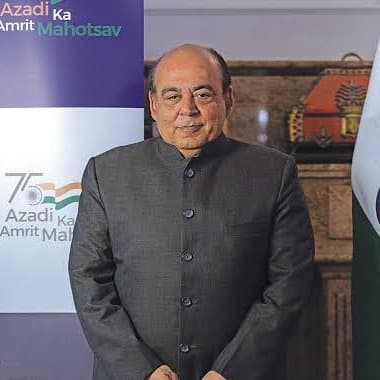
Amb Sanjiv Kohli

Amb Sanjiv Kohli, IFS · Nearly Four Decades in the Indian Foreign Service

Stated Principles · Issue No. 010

Amb Sanjiv Kohli

The Capacity to Listen Is One of the Most Potent Tools of Diplomacy

Former High Commissioner & Ambassador · Indian Foreign Service, IFS

“Leadership is not about possessing authority. It will be tested around how that authority is exercised.”

Format

Leadership Principles

Read time

9 minutes

Principles

8 stated

Published

August 2026

Indian Foreign ServiceDiplomacyFormer High CommissionerFormer AmbassadorLeadership

About this feature

“We asked Amb Sanjiv Kohli nine questions. He gave us nearly four decades of representing India across different capitals and circumstances.”

Amb Sanjiv Kohli, IFS, began his diplomatic career about 38 years ago and has represented India in roles including High Commissioner and Ambassador, across regions and circumstances ranging from routine bilateral relationship-building to a pandemic that left tens of thousands of Indian nationals stranded with no direct way home.

What follows is not a Q&A. It is a record of what he stands for, stated publicly, in his own words. This is how Stated Principles works: the person states their beliefs. We make them visible. You decide what to carry forward.

Eight principles · Stated by Amb Sanjiv Kohli

What he stands for — in his own words.

01 of 08

Value Systems Are Never Frozen

I believe that our value systems are not frozen at any point of time. These are being continuously shaped by our experiences and learnings. There is, hence, continuous reshaping, reinforcing, and expansion of our basic personality traits. As for me, each of my assignments helped me to broaden my worldview through exposure to new environments and ideas.

As an Indian diplomat, you are also representative of the idea and image of India, as perceived by the outside world. We, as Indians, are most admired when seen as a true representative of our country's cultural heritage that has always nurtured the concept of unity in diversity, as also of our civilizational values such as compassion, empathy, tolerance and human dignity.

This belief has always stayed with me as a guiding principle. It is important that the conduct of every Indian reinforces the very positive perception of India.

— Amb Sanjiv Kohli, stated directly

What this means

He starts from a premise many people resist admitting: that values aren't fixed early in life and then simply carried forward. Each posting, each new environment, kept reshaping and expanding his own worldview, not just adding to it.

Why it matters

His non-negotiable isn't a personal rule so much as a shared responsibility: he ties individual conduct directly to how India itself is perceived abroad, unity in diversity, compassion, tolerance, human dignity, treating every Indian representing the country, formally or not, as part of that same reputation.

Reflect on this

Which of your own values have genuinely been reshaped by experience, rather than simply reinforced by it?

Create a Commitment inspired by this

02 of 08

The Capacity to Listen Is One of the Most Potent Tools of Diplomacy

In my view, which can sound contrarian to many, the capacity to listen to others with patience and a constructive mindset is one of the most potent tools of diplomacy. And when it comes to dealing with diverse governments and people, our capacity to listen to them not only underlines our basic humility but also respect for their point of view, which may not be fully aligned to our own.

Arrogance or indifference to the other side's sensitivities only leads to breakdown of negotiations, or at best to outcomes that will not sustain. Relationships are built through decades of hard work and incremental accumulation of goodwill. Listening to each other helps to build trust and strengthen mutual respect and understanding.

In fact, all public servants need to listen more to provide the necessary level of comfort and reassurance to those who approach them for finding solutions to their grievances.

— Amb Sanjiv Kohli, stated directly

What this means

He calls this view contrarian, which is itself worth noticing: in a field often associated with negotiating leverage and firm positions, he places patient listening, not persuasion, as the more potent tool. Respect for a viewpoint that doesn't align with your own is treated as a form of humility, not concession.

Why it matters

"Relationships are built through decades of hard work and incremental accumulation of goodwill" is a deliberately slow, unglamorous account of how trust actually forms between nations, and by extension between people, a position that resists the pull toward quick wins.

Reflect on this

In your own dealings with people who see things differently than you do, are you listening to understand their position, or listening for the gap where you can make your own case?

Create a Commitment inspired by this

03 of 08

We Take Full Ownership of the Consequences

We must realize that the practice of diplomacy is always confronted with challenges of all sorts, such as sovereignty and national interests, domestic political compulsions, geopolitical rivalries, shifts in alliances, ideological differences, and more. Modern media and a turbulent world order add further complexity to the tasks of diplomats.

An ambassador also carries the responsibility to find a balance between the positions of the country he represents and the country he is posted in. His statements and conduct are, in a sense, under double scrutiny by the stakeholders and interest groups on both sides.

India has the largest diaspora globally. The well-being and expectations of our nationals, particularly that of the most vulnerable category of unskilled and semi-skilled workers, have always been the most important part of our work. It usually is also one of the most sensitive aspects of our mandate. The embassy has no legal jurisdiction over the employer. The embassy is also generally constrained in approaching authorities other than the host foreign ministry directly.

Given the multiplicity of challenges and the uncertainty that is integral to the environment in which a diplomat operates, we can all recall several instances where we had to take decisions based on our best judgement, knowing fully that we would also need to take full ownership of its consequences.

Let me recall a rather recent instance. I was the High Commissioner to Tanzania during the COVID time. Tanzania was one of the many countries where a vaccination facility was not available, and there was mounting panic in the Indian diaspora. There was no direct flight to India, and transits were difficult due to different COVID-related restrictions.

Our government subsequently decided to run special flights to some of these countries. However, Tanzania was not on that list, though we had over 50,000 registrations of people desperate to travel. Having been left with no official option, we decided to take upon ourselves the responsibility to negotiate sending chartered flights. We had to organize the community into groups, where the group leader would collect money directly, and the embassy would negotiate rates for booking chartered flights.

We were finally able to facilitate the travel of all the registered people, at rates lower than what the government had charged for flights arranged by them directly.

— Amb Sanjiv Kohli, stated directly

What this means

Rather than describe a single dramatic decision, he describes the structural condition every diplomat operates under: incomplete information, competing loyalties, no legal authority over the actual problem, and full ownership of whatever happens next regardless.

Why it matters

The Tanzania story is the clearest possible illustration of that condition. With no official pathway and 50,000 people registered, he and his team built one, organizing the diaspora into groups and negotiating charter rates directly, and it worked out cheaper than the government's own arranged flights.

Reflect on this

When you've been left with no official option for something that genuinely mattered, did you build an unofficial one, or wait for permission that wasn't coming?

Create a Commitment inspired by this

“We decided to take upon ourselves
the responsibility to negotiate.

Amb Sanjiv Kohli — Principle III, Stated

04 of 08

The Letter of Credence Is a Privilege and an Enormous Responsibility

There can certainly be no honour greater than representing the country in a foreign capital. The letter of credence that an ambassador carries is an official communication from the Hon'ble President to the Head of State of the receiving country, requesting the receiving government to trust everything the Ambassador says on behalf of his country, and confirming that the Ambassador has full power to speak for his home country.

This document not only confers huge privilege but also entrusts you with the enormous responsibility to be the chief interlocutor for the national interests of your country. This sense of responsibility only grows with time.

— Amb Sanjiv Kohli, stated directly

What this means

He explains the letter of credence not as a ceremonial formality but as a literal transfer of trust, a foreign government agrees, on paper, to believe whatever the ambassador says on India's behalf. That's the privilege and the weight in the same document.

Why it matters

"This sense of responsibility only grows with time" is a quiet but telling detail. He doesn't describe the weight of representing a nation as something that becomes routine with experience. It becomes heavier.

Reflect on this

Is there a form of trust placed in you that you've come to treat as routine, rather than as something that should still feel weighty?

Create a Commitment inspired by this

05 of 08

Navigating These Challenges Requires Agility, Composure, Patience

I touched upon the nature of challenges a diplomat needs to grapple with. I also spoke about the balance one needs to find between expectations from both sides, some of which can be competing in nature. The Ambassador needs to develop local constituencies of support in different circles, such as media, business, and think tanks.

The nature and scope of these challenges also depend upon the state of bilateral relationships. Building and nurturing relationships always remains a work in progress. It is important to ensure that minor irritants are not allowed to get magnified into the possibility of a rupture of the relationship. At the same time, one cannot let noise or headlines become a distraction.

Navigating these challenges requires agility, composure, patience, and laser-sharp focus on the body of shared interests and values that bind the two countries and their people. It also needs building a stake in each other's well-being, and a continuing effort to add more substance and ambition into bilateral engagement.

— Amb Sanjiv Kohli, stated directly

What this means

Answering two questions together, on staying composed under pressure and on building trust across differences, he treats them as the same underlying skill: the discipline of not letting minor irritants become ruptures, and not letting headlines dictate the relationship's direction.

Why it matters

"Building a stake in each other's well-being" reframes bilateral relationships as something more durable than aligned interests. Interests shift with circumstance; a stake in the other side's well-being is a steadier foundation to build on.

Reflect on this

In a relationship, professional or personal, that matters to you, are you letting a minor irritant get magnified past its actual size right now?

Create a Commitment inspired by this

06 of 08

We Are No Longer Part of the Problem. We Are Part of the Solution

I started my diplomatic career about 38 years ago. Our country has made remarkable progress. Our increased strength and capabilities have obviously led to a qualitative change in the breadth and depth of our international engagement. Our interests extend much beyond our region.

We are no longer considered as part of a problem. We are now seen as a part of the solution. The world pays attention to us because they see us as an economic powerhouse, a rising middle power with a significant military and technological muscle. This rise obviously gets reflected in the aspirations of our youth.

At the same time, there are multiple headwinds and challenges that we need to overcome to achieve the goal of being a developed country. The increasing threat to world order posed by the coercive and transactional foreign policy approach of the Trump administration, the undermining of multilateralism, and the rise of China, among other factors, could seriously impact our national interests.

While at the foreign policy level we are trying to safeguard our strategic autonomy by following a policy of issue-based multi-alignment, we need to build our national strength in areas of vulnerability and in sectors where we have critical dependency on other countries, particularly in areas of technology and critical inputs for our industry.

— Amb Sanjiv Kohli, stated directly

What this means

Looking back across 38 years, he traces a shift in how the world positions India, from being treated as part of a problem to being treated as part of the solution, driven by economic weight, military and technological capability, and rising global attention.

Why it matters

He doesn't stop at the achievement. He names specific present-day headwinds, a more transactional and coercive global order, strained multilateralism, rising dependency in technology and critical industrial inputs, as the real work still ahead, rather than treating India's rise as a settled story.

Reflect on this

Where in your own field has real progress made you assume the hardest part is behind you, when the harder part may actually be what comes next?

Create a Commitment inspired by this

07 of 08

Leadership Will Be Tested Around How Authority Is Exercised

A leader needs to lead from the front. A good leader must be a team builder and an inspirational figure. Impactful leaders communicate clearly and openly. Accountability and integrity need to be their defining traits.

Leadership is not about possessing authority. It will be tested around how that authority is exercised. Having said that, it is also true that leadership is a process of continuous learning and growth.

— Amb Sanjiv Kohli, stated directly

What this means

He separates having authority from being a leader entirely. The first is a position; the second, in his account, is only proven by what someone actually does with the authority they've been given.

Why it matters

Ending on leadership as "a process of continuous learning and growth," rather than a fixed set of traits someone either has or doesn't, keeps the definition open rather than treating leadership as something achieved once and then simply held.

Reflect on this

Think of the authority you currently hold, in whatever form. Would people around you say it's being tested well, based on how you're exercising it, not just on the fact that you have it?

Create a Commitment inspired by this

08 of 08

Equipping India's Youth With the Knowledge, Skills and Character

We are the most youthful nation in the world. The youth of India will have the global stage as their playfield. They will therefore be ideally placed to fulfil the unfinished agenda of securing for the country its rightful place.

As a country, we need to introspect on whether we are creating the right conditions to equip them with the knowledge, skills and character to take up the responsibility that awaits them.

— Amb Sanjiv Kohli, stated directly

What this means

Asked both for a principle to leave with young people and for a lesson he wishes he'd understood earlier, he answers with the same thought turned outward: the responsibility isn't only on the next generation to rise to the moment, it's on the current generation to ask honestly whether it's actually equipping them to.

Why it matters

"Fulfil the unfinished agenda" ties directly back to Principle 6, India seen as part of the solution rather than the problem, framing that shift as work still in progress, carried forward by the youth who inherit it rather than completed by the generation before them.

Reflect on this

If you're in any position to shape what the next generation inherits, whether at home, at work, or in your community, are you asking honestly whether you're equipping them, or simply expecting them to manage?

Create a Commitment inspired by this

“We are no longer considered as part of a problem.
We are now seen as a part of the solution.

Amb Sanjiv Kohli — Principle VI, Stated

Key takeaways

Six ideas worth carrying forward

  1. 1

    Value systems are never frozen. Experience continuously reshapes, reinforces, and expands who you are. Every new environment is a chance to broaden your worldview, not just confirm it.

  2. 2

    Listening is one of the most potent tools of diplomacy. Respecting a viewpoint that doesn't align with your own is humility, not concession. Trust is built through decades of incremental goodwill, not single wins.

  3. 3

    Take full ownership of the consequences. When left with no official option, build one. With 50,000 people registered and no pathway home, that's exactly what happened.

  4. 4

    Responsibility should grow heavier with time, not lighter. The weight of representing something larger than yourself shouldn't become routine just because you've carried it for years.

  5. 5

    Leadership is tested by how authority is exercised, not by whether you have it. Possessing authority is a position. What you do with it is the actual test, repeated continuously, never finished.

  6. 6

    Ask whether you're equipping the next generation, not just expecting them to rise. The unfinished agenda belongs to those who inherit it, but the conditions that prepare them for it belong to those who came before.

Which principle resonates with you?

Post a commitment inspired by Amb Sanjiv Kohli's principles. State it publicly — and make it real.

Create a Commitment

Share this feature

9 min read · 8 principles

app.stated.in/principles/amb-sanjiv-kohli

All Stated Principles features