01 of 16
Leadership Is an Act of Service Before It Is an Exercise of Authority
When people ask me what has remained constant throughout my military journey, my mind does not immediately travel to the battlefields where I served, the appointments I held or the decorations that came my way. Instead, it returns to the young gentleman cadet who walked through the gates of the National Defence Academy in January 1976, carrying little more than youthful enthusiasm, a deep love for his country and an incomplete understanding of what it truly meant to lead men. Like every young officer, I believed that courage was the defining quality of a soldier. It took me many years to realise that courage is only one part of leadership; character is what sustains it over a lifetime.
If I were asked to identify one principle that has guided me through nearly four decades in uniform, it would be this: leadership is an act of service before it is an exercise of authority. This belief was not acquired overnight. It was forged gradually through countless experiences, some inspiring, some painful, many humbling. Whether commanding a platoon in difficult terrain, leading troops in counter-insurgency operations, serving in the unforgiving environment of the Siachen Glacier, representing India abroad or later working to bring insurgent groups into dialogue, I found that the essence of leadership remained remarkably unchanged. People do not follow rank alone. They follow conviction. They follow fairness. Above all, they follow leaders whom they trust.
The Indian Army's motto, Service Before Self, is often quoted, but I believe its true meaning reveals itself only after years of living it. It is not about denying oneself recognition or comfort for its own sake. It is about recognising that, once you accept command, your personal preferences become subordinate to a much larger responsibility. The mission comes first. The nation comes first. The welfare of the men and women entrusted to your command comes first. Every significant decision I made was, in one way or another, influenced by that simple hierarchy of priorities.
There is a tendency to believe that leadership becomes easier as one rises in rank. My experience was exactly the opposite. Every promotion expanded not merely my authority but my accountability. As a young officer, I was responsible for a platoon. Later I commanded battalions, formations and organisations. Eventually, decisions carried strategic implications that extended far beyond the immediate battlefield. Yet regardless of the scale of responsibility, I found myself returning to the same fundamental question: What is the right thing to do, not for me, but for the institution, for my soldiers and for the nation?
The years also taught me another important lesson. Leadership is rarely about dramatic moments. Popular imagination often associates military leadership with combat, crises and decisive operations. Those moments certainly test one's resolve, but they are relatively few. The true test of character lies in ordinary days, in whether one treats the youngest soldier with dignity, whether one remains honest when compromise appears convenient, whether one accepts responsibility when mistakes occur, and whether one continues to uphold standards even when no one is watching. Trust is not built during battles; it is built during routine interactions long before the battle begins.
Looking back now, I realise that the Army gave me far more than a profession. It gave me a philosophy of life. It taught me discipline without rigidity, courage without arrogance and authority tempered by humility. It introduced me to extraordinary soldiers from every corner of India who demonstrated, through quiet professionalism rather than grand speeches, what devotion to duty truly means. Whatever leadership qualities people may attribute to me are, in reality, a reflection of the institution that shaped me and the remarkable men and women with whom I had the privilege to serve.
Today, in retirement, when I write, teach and engage with younger generations, I find that the principle remains unchanged. Leadership is still about service. Titles eventually disappear, uniforms are folded away and appointments pass into history. What endures are the institutions one leaves stronger, the people one has inspired and the values one refused to compromise. If there is one idea I would wish every young leader to carry forward, it is that leadership is never about oneself. It is a sacred trust placed in one's hands by others, and the only honourable way to repay that trust is through selfless service.
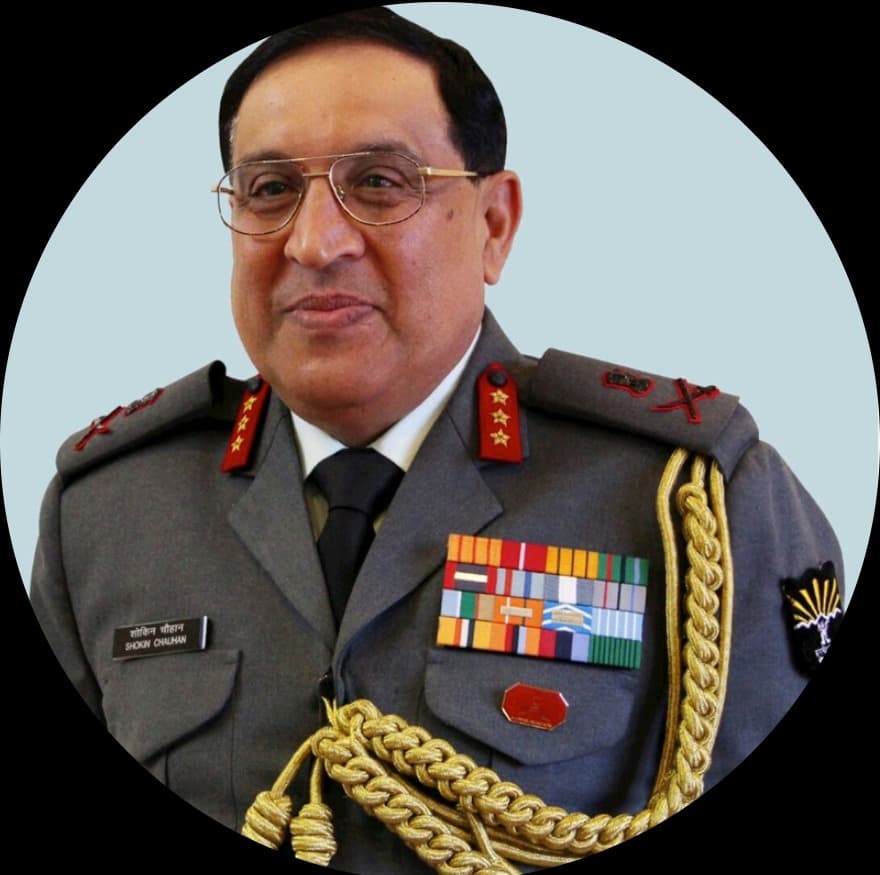
— Lt General Shokin Chauhan, stated directly
What this means
He locates the source of his leadership philosophy not in a single defining moment, but in the slow realisation that courage — the quality every young officer admires first — is only the entry point. Character is what has to sustain leadership over an entire career, long after the dramatic moments have passed.
Why it matters
"Service Before Self" is a motto most people hear as a slogan. He treats it as an operating principle with a strict order of priority: mission, then nation, then the people under your command — with personal preference subordinated to all three.
Reflect on this
In whatever you lead, is your personal preference currently ranked above or below the people you're responsible for?